


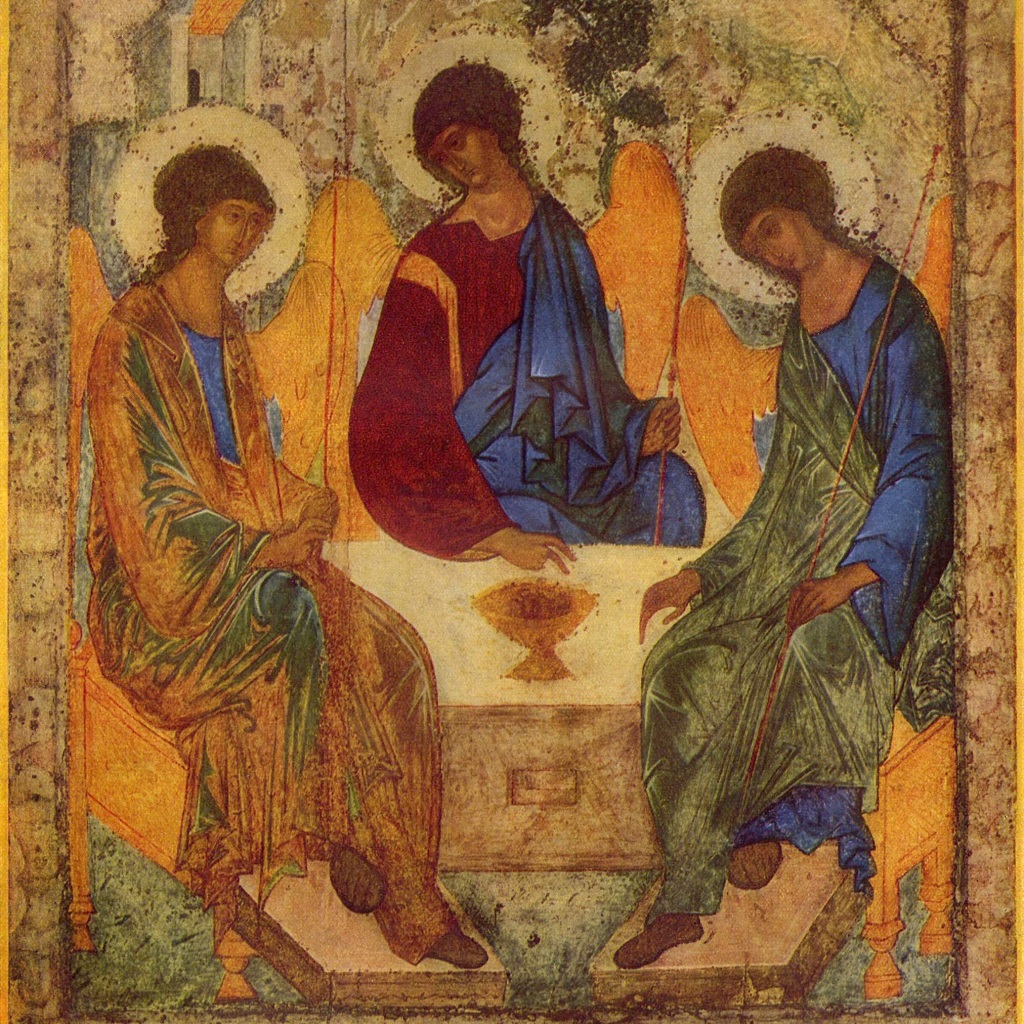
Already in the culture of the Old TestamentPart of the Bible with texts from before the birth of Jesus. we have the age-old story of Abraham and his wife Sarah (Gen. 18:1-10), who receive their three mysterious guests with much attention and servitude. Even though this story of the patriarch mainly functions in the art tradition of the orthodox Christians as the representation of the Holy TrinityThe concept that there is one God who shows himself in threefold form: Father, Son (Jesus of Nazareth) and the Holy Spirit., it is still known as the ‘Philoxenia (Hospitality) of Abraham’: hospitality shown to the stranger (even though here in the form of angels) who is God.
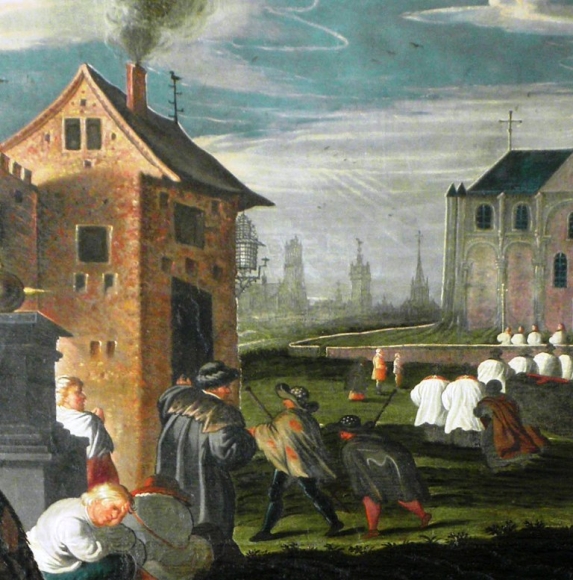
In Jesus’ Joyful Message this identification of God with a stranger is taught us as the deepest inspiration for receiving a guest. And so Christian charity is put thus (Mt 25:35): “Because… I was a stranger and you gave Me shelter”. It is God Himself who comes (knock¬ing) at your door and who will, on the Day of Judgement, take this good deed of charity into good account.
There is also the scene of Jesus with Martha and Mary (Luke 10:38-42), which is often explained theologically as an inspiration to receive your guest really well, i.e. as completely concerned with the person of the guest, and not to lose oneself in all kinds of trivialities.
Hospitality is repeatedly praised as an especial virtue by the apostleThis is the name given to the principal twelve disciples of Jesus, who were sent by Him to preach the gospel. By extension, the term is also used for other preachers, such as the Apostle Paul and Father Damien (“The Apostle of the Lepers”). Paul, certainly for leaders (Romans 12, 13; 1 Tim.3:2; 1 Tim.5:10; Tit.1:7-8). Peter also (1 Peter 4:9) urges his public to show hospitality… without grumbling. And the letter to the Hebrews (13:2) obviously refers back to Abraham: “Do not forget hospitality, because in this way some have given shelter to angels without knowing it”.
At the end of the Roman Empire there are already here and there Christian institutions where strangers and the needy poor are given shelter and care, and who are really guests. The Hôtel-Dieu (i.e. ‘guesthouse for God’) in Paris dates as such from in the 7th century. In the Balkans an xenodochium is known as a typical guest-house for strangers.
It is especially the Benedictine monks in the early Middle Ages who have contributed to the founding of hospitals for passers-by. Their rule (approx. 540) commands them to receive every guest as Christ, and this is why they attached guest-quarters or hospitals for all kinds of passers-by to their abbeys.
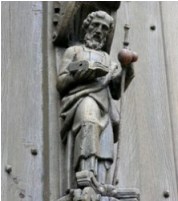
The large pilgrimage-routes are a separate chapter, with as a peak the one to St. James of Compostela in Northern-Spain, where a whole chain of charitable hostelries were founded, which were either run by monasteries, by ex-pilgrims or other individuals for the benefit of the pilgrims. As in many places, there was also such a pilgrim-house, with a chapel
A small church that is not a parish church. It may be part of a larger entity such as a hospital, school, or an alms-house, or it may stand alone.
An enclosed part of a church with its own altar.
outside the old city walls, in Antwerp in the 15th century, situated as it was on the Compostela-route which ran from Northern Europe to Paris. It was this chapel which formed the base for the really monumental St. James’ church. In the 16th century one could find this guesthouse in the Prinsesstraat.
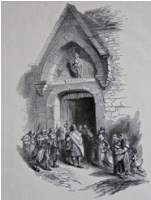
In the numerous travel journals of pilgrims to Compostela one can read examples of hospitality. Once a village-woman greeted Jan van Doornik and his companion Willem with a freshly cooked omelette: such a friendly action always makes food taste better of course.
But hospitality is also used to conduct business and even to rob someone of his money in a devious manner. The famous legend of St. James which tells how an innocent hanged man is saved in Toulouse by him, after which the greedy, criminal innkeeper is sentenced to death, emphasizes that a true Christian must resist any kind of attempt to cheat a stranger.
Several saints such as St. Julianus (‘Hospitator’) and St. Gertrude of Nijvel (both of the 7th century) became the patron saints of hospitals because they themselves showed hospitality in such an exemplary way. In Antwerp too we have a St.-Julianus hospital.
As regards the Crusades, actual hospital knight-orders were founded, such as the Order of St. John of Jerusalem (the so-called Maltese Order) (approx.1040) and the German Order (1190), founded to receive the pilgrims and to protect them against the Muslim-enemies.
More peaceful is the race of the Saint-Bernard dogs, which are, just like the two Swiss alp passes and mountains, named after St.-Bernard of Menton who founded an abbeyA set of buildings used by monks or nuns. Only Cistercians, Benedictines, Norbertines and Trappists have abbeys. An abbey strives to be self-sufficient. there in 962. The monks saw it as their duty, with the aid of the dogs, to search for lost or buried travellers. The gratitude of the people who were saved was not small, and in this way the fathers received donations throughout Europe.
From the 13th century on many guesthouses in the cities evolved into nursing-houses (our modern ‘hospitals’), where the sole concern was the medical care of their own citizens, who were nevertheless still ‘hospitalised’ there.
As travelling became more and more accessible for the ordinary citizen, the number of commercial exploitations rose: inns and guesthouses in the countryside and from the 18th century onwards also hotels in the cities. In Antwerp there were among others “Le Grand Laboureur” (Meir) and “Sint-Antonius van Padua” (at the present Groenplaats). In the 19th century hotels mushroomed near big railway stations, which was also the case in the quarter round Antwerp Central StationOne of the fourteen stages of the Way of the Cross: Jesus is sentenced to death.
Jesus takes up the cross.
Jesus falls the first time.
Jesus meets His mother.
Simon of Cyrene helps Jesus carry the cross.
Veronica wipes Jesus’s face.
Jesus falls the second time.
Jesus comforts the mourning women.
Jesus falls the third time.
Jesus is stripped naked.
Jesus is nailed to the cross.
Jesus dies.
Jesus is taken down from the cross.
Jesus is laid into a tomb.
. Because of democratization of travelling in the 20th century the number of small hotels and boarding houses decreased in favour of new hotel chains. The mobility of the car has invited them near the circular road, whereas smaller hotels prefer the attractive historic town centre.
Campers and youngsters have their own accommodation (a camping-site and a youth hostel), but in a port like Antwerp seamen deserve special attention. The government had the first International House for Seamen built in 1894 and in 1954 it moved to a new building in Falconrui. It wants to be neutral, whereas the churches were the first to take care of seamen to protect them against “immoral rootlessness”. Because around 2000 mobility has increased so that seamen and truckers no longer stay for weekends, Scandinavian national churches put a stop to about 125 years of social service and the once so hospitable churches were sold. In ecumenical solidarity catholic, Anglican and protestant Christians work together in the “Antwerp Seafarers’ Centre” or the “Stella Maris Seamen’s Club” (72 Italiëlei), an international meeting place where many a seaman far from home can feel “at home” for a short time.